Diamond Painting Profit Formular
Need Help? [email protected]
Art Selling System
Diamond Painting Profit Formula
Need Help? [email protected]
For Women Who Paint And Want Buyers To Come To Them
New Ebook Reveals A Counterintuitive Approach That Gets Your Paintings Bought
New eBook Shows You How to Sell Your Diamond Painting Before You Start Making It
Without Chasing Anyone, With An AI Helper Doing The Heavy Work
So You Get There Quicker
While also putting your Amazing painting on the wall of every buyer who loves it
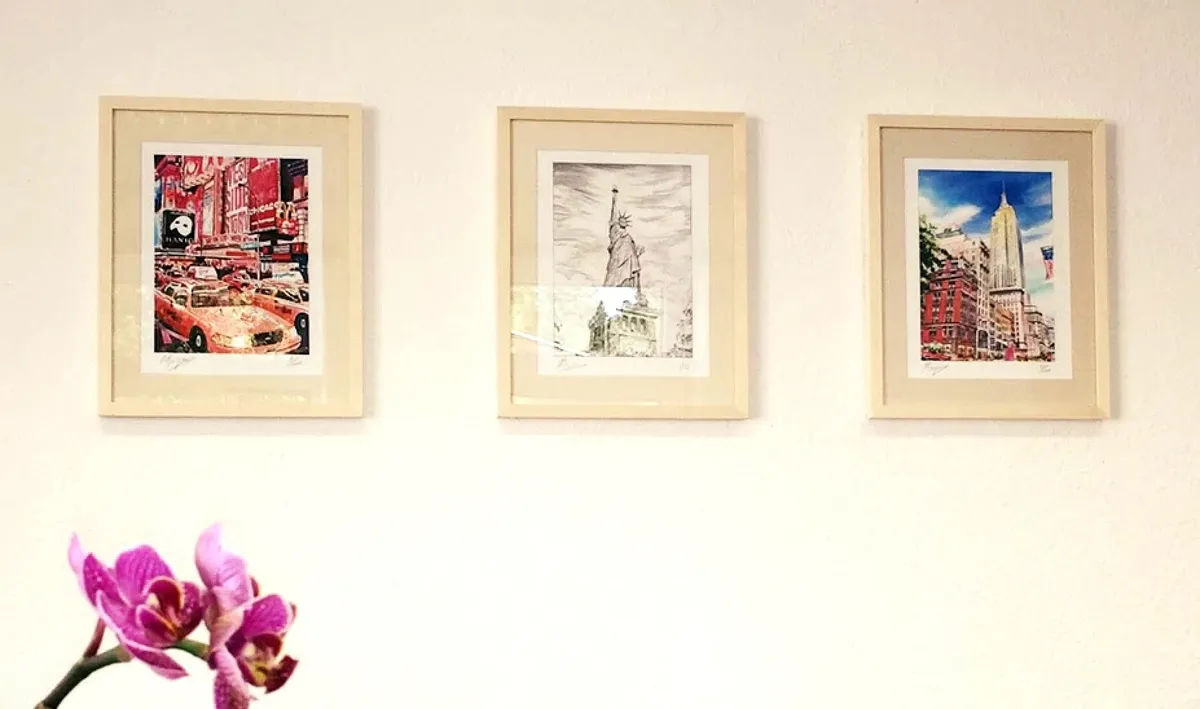
Bruce’s prints, framed and hanging at home.
What is the Art Selling Systeum?
What is the
Diamond Painting
Profit Formula?
The Art Selling System is a counterintuitive way to make your first sale to a stranger,
selling your prints online, one small step at a time -
without a booth, chasing anyone or posting everyday.
We achieve this by starting you with the smallest step a stranger can say yes to,
then letting them move up only when they want more.
You never have to ask a stranger to make a big decision about your work on the first visit.
And as a result, you get to spend your evenings painting, while the prints do the reaching out and can be ordered online at any hour, even while you sleep.
This is The Art Selling System.
One painting at a time, and you can pause the selling side whenever you like.
The Art Selling System is a shortcut
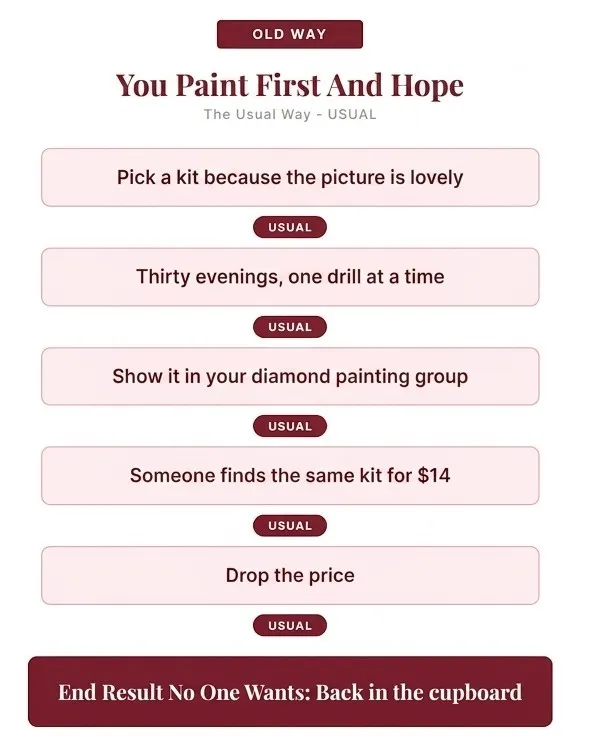
Stop painting first and hoping someone wants it. Here's the order that works instead
One system, three steps:
a small print, a larger print, your original
Most painters start with one big original and a stranger asked to decide on the spot.
The Art Selling System starts a step lower,
with a small print a stranger can say yes to.
We built that step in 2017 with Bruce, a New York
watercolourist whose originals had become hard to sell.
We made buying easy.
Each print was signed by hand, numbered,
printed on high-quality paper,
and sold online in limited editions with his permission.
His originals stayed with him till go to the people who love them most, at their full price.
It is a sequence of buyers, each at a price that suits her,
in three steps, plus one AI helper that does the tiring part.
You can see each step before you take it.
Step 1 is the small print, signed and numbered, at a gift-sized price.
This is for the buyer who loves the painting and cannot afford the original.
A stranger starts here, because it is a small, safe decision about a painting she already likes.
Step 2 is the larger print, for the buyer with a wall to fill.
It is priced higher than the small one, and a limited edition makes it rarer.
Step 3 is the original, sold at full price, in person, to the buyer who can afford it. The people who reach it are mostly the ones who started on Step 1.
One painting serves all three buyers.
The buyer with a small budget is not turned away,
and the buyer with a large budget does not get a cheaper version of what she came for.
The print does not compete with your original.
It brings in the buyer who would not have reached it.
You always know which step you are on, and what comes next.
The Art Selling System is that same order,
set out as a process you can follow one evening at a time.
Here’s how it works:
Now available for
instant digital download
Limited Time Offer:
Price today
Only $133 $12.47
Save over $120 today
The 253-page ebook · 15 chapters ·
8 PREMIUM Gifts ·
59 ready-to-use AI prompts
Made for women who paint their own originals in watercolour, acrylic, oil, gouache or pastel
A print for the buyer who loves it but can't afford the original
Your original, sold at full price to the buyer who can
No gallery to join, no shop to rent,
no restaurant wall to fill
Download The eBook For $133
JUST $12.47!
One Payment Lifetime Access
Delivered instantly.
Start reading in the next 2 minutes.
Now Available For Instant Download
Now Available For
Instant Access & Constant Update

100% secure 256-bit encrypted checkout

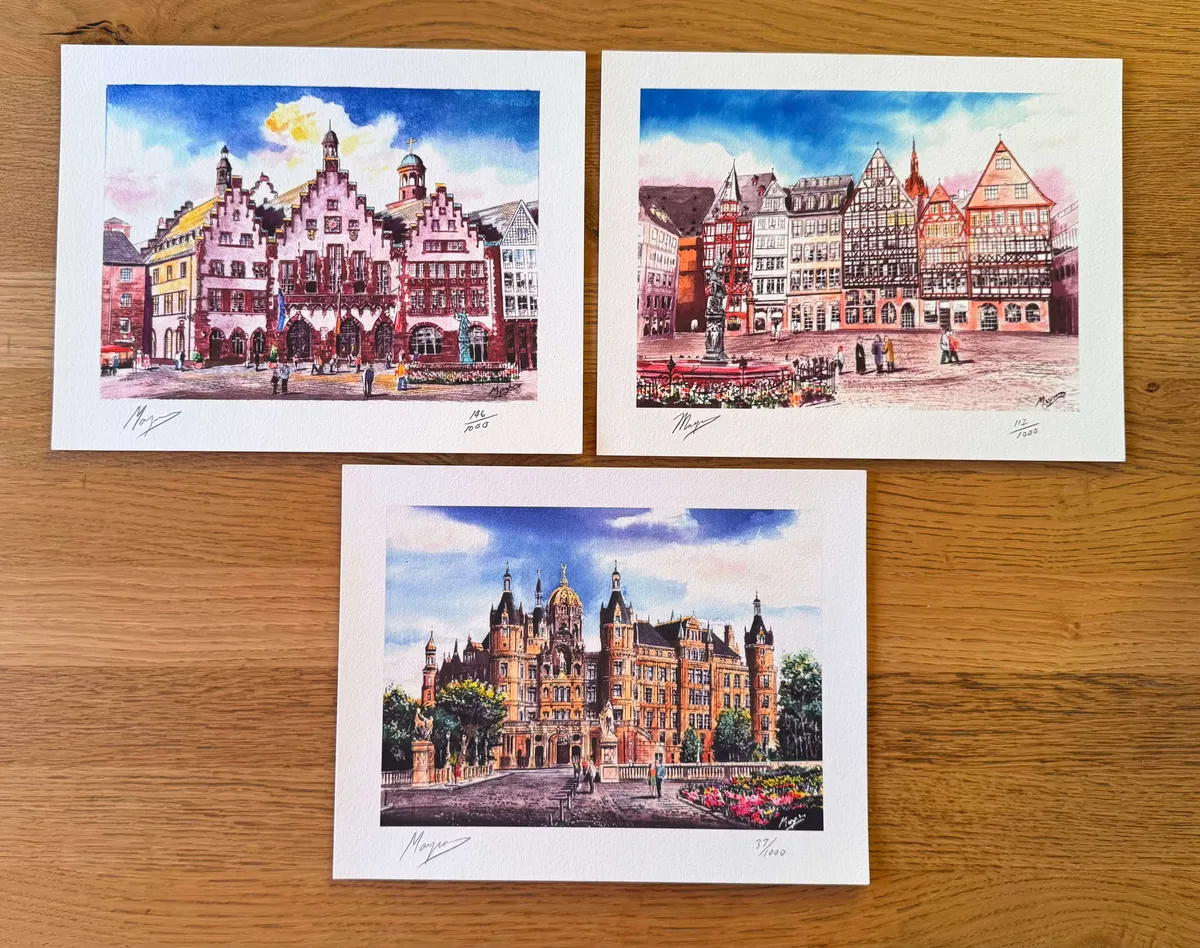
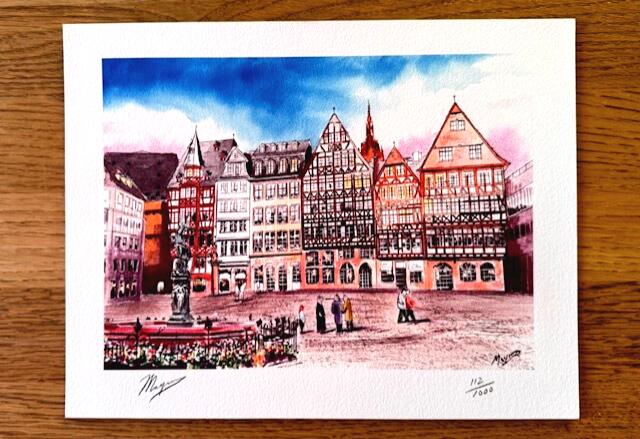
Bruce’s small prints: the first step a stranger can say yes to.
Your friends say your paintings are lovely.
No stranger has bought one yet, and it isn't your talent
Picture the moment.
A friend stands in your kitchen, looks at the painting propped against the dresser,
and says, "Oh, that's lovely. You should sell these."
You smile and say thank you.
Behind the smile, the question comes back: then why hasn't anyone?
Look at that painting again.
You chose the colours, you made the light fall where it falls,
and someone you hardly know stopped in front of it and said it was lovely.
That is real skill, and it is why you can't see why it hasn't sold.
A painting like that does not need to be better.
It needs a way to reach someone who doesn't know you yet.
You may have listed one and watched it collect a handful of views.
You may have given a painting to your sister because no one else asked.
The stack in the spare room grows by one or two a season, and a quiet voice says maybe you're just not good enough.
Two painters put it in their own words.
"I have more than 160 likes over the course of the month, yet still no sales!"
And: "I do not know why people love my art but do not buy it."
That quiet voice blames the wrong thing.
Your painting is fine. The setup around it is the problem.
The few people who can afford an original have to trust a painter they found five minutes ago.
The rest love the painting and have nothing smaller to buy.
We saw the same thing in 2017 with Bruce, a New York watercolour painter.
People still loved his paintings. The buyers for his large originals had dried up.
The ordinary route asks each stranger to begin at the top, with the original.
Think of the last new maker you bought from.
You started with something small, saw how it felt in your hands, and bought the bigger piece once you trusted them. Strangers buy paintings the same way, and no one told you that.
You don't need a gallery,
a Rented shop or a restaurant wall
Most painters are told the same three things.
Get into a gallery.
Rent a little shop.
Hang your work in a restaurant and hope someone asks the price.
Each one costs you something before it sells anything.
A gallery takes its share and decides when your painting is seen.
A shop of your own ties you to opening hours and
a rent that arrives whether anyone comes in or not.
A restaurant wall costs you a painting and a trip to hang it,
and the diners who admire it over dinner are not there to buy a painting.
Online, the small print does the work those places were supposed to do.
Your little webshop is open at all hours, so you are not sitting beside your work waiting.
A stranger can find a painting she loves, buy a print for a gift-sized price,
and never ask you a thing. That is the time you get back, and it goes to your brush.
So the answer is not a better gallery or a busier fair.
The answer is a different order: a small print online first, your original in person last.
The #1 mistake everyone else makes
The most common mistake is offering only the top of the ladder,
which means only the large original, to strangers who have just met you.
A buyer who wants to feel safe needs a smaller first step,
one she can take without a big decision about someone she has only just found.
We don't focus on the things that keep painters stuck
You won't be asked to:
show your face on camera
post every day
rent a booth, a fair stand or a restaurant wall
buy expensive equipment or courses
spend money on ads before you're ready
Ads are there later, if you want them, and only after you've seen how your first print behaves.
They are not the first step.
Here's how it works
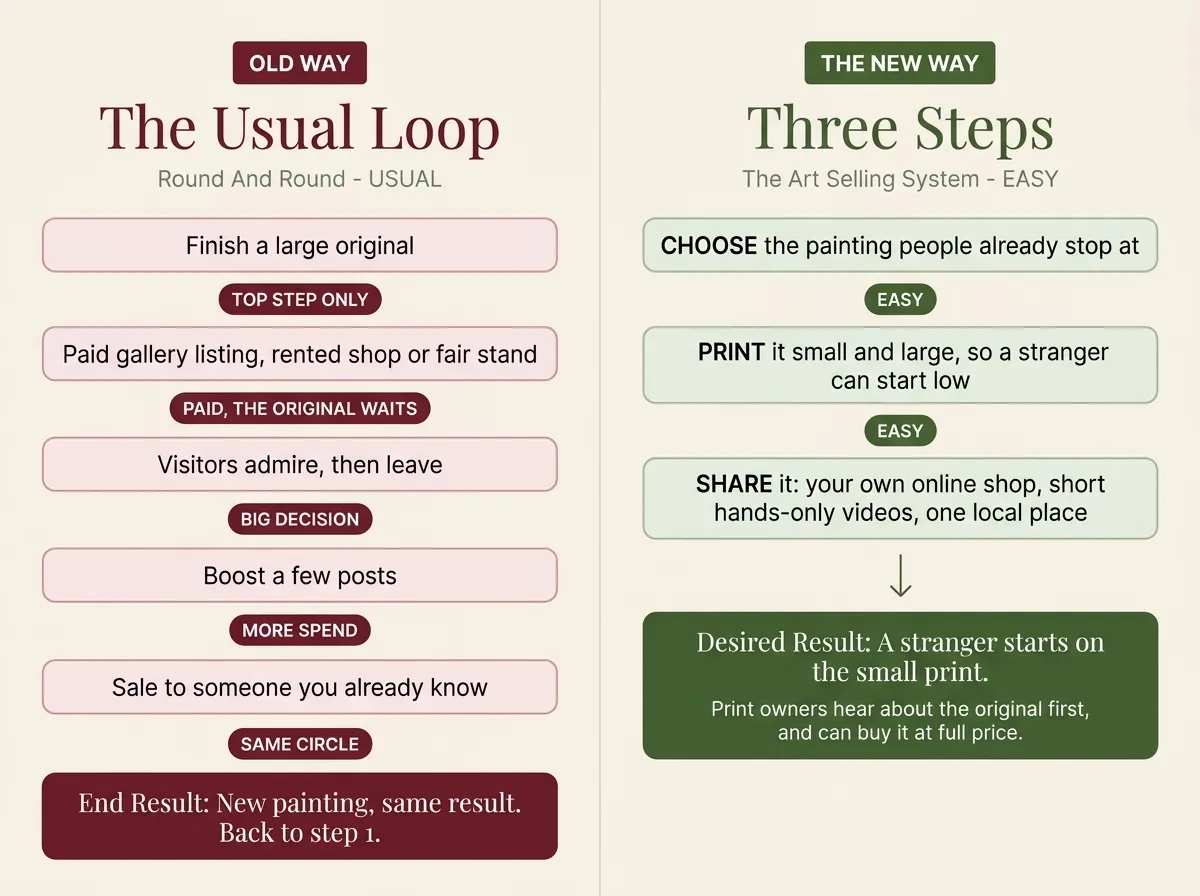
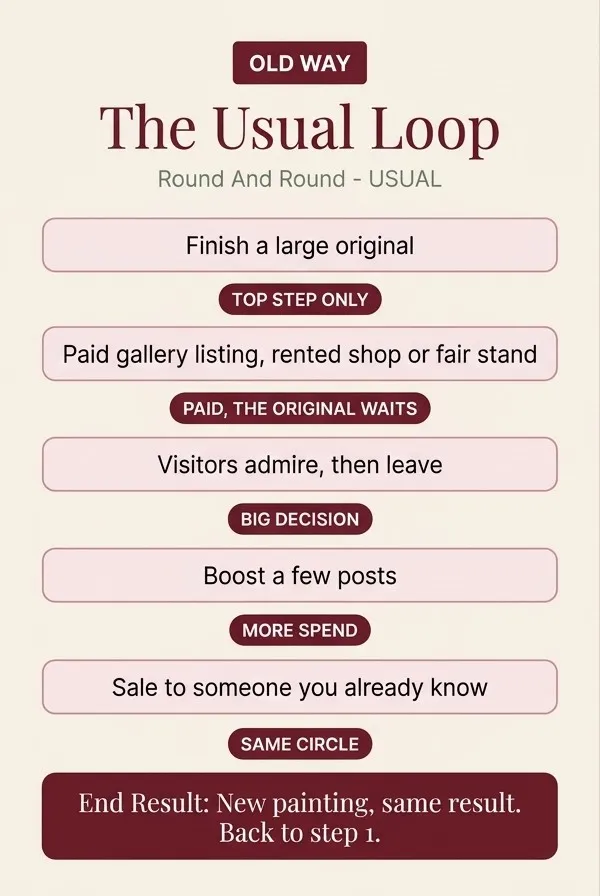
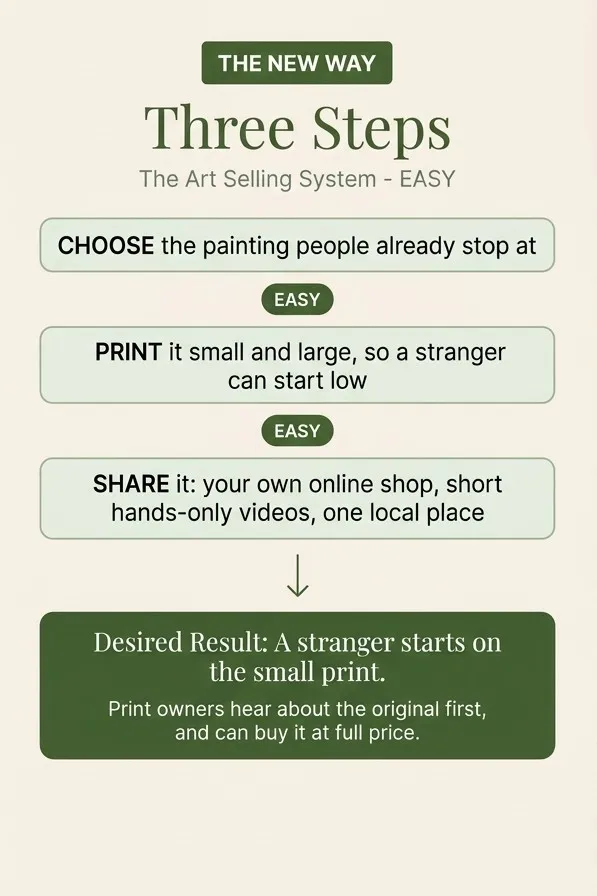
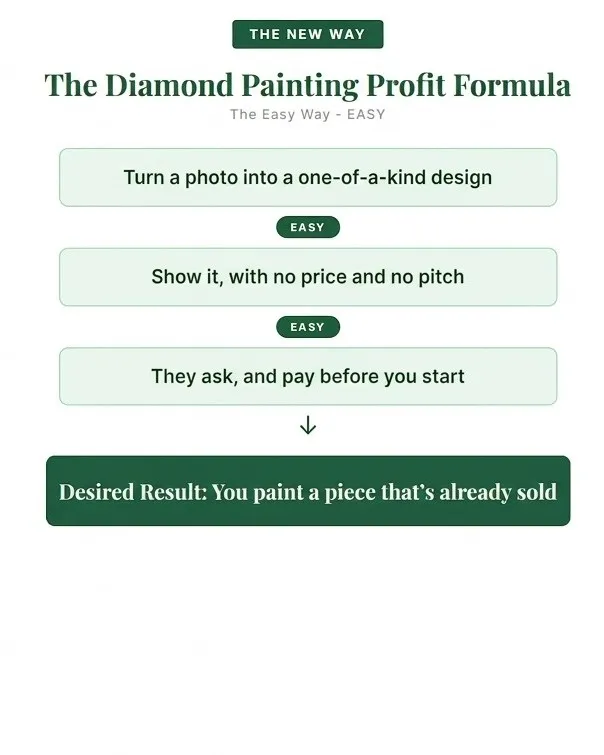
The left side has six steps and brings you back to where you started.
The right side has three, and none of them asks for more than an hour or two at a sitting.
Choose.
A five-question test and three phone checks pick the painting with the best odds.
Your AI helper does the first sort from your photos in about fifteen minutes,
so you aren't guessing before you've spent an evening on it.
Bruce's subjects already had people who loved them:
the Brooklyn Bridge, Rockefeller Center at Christmas, Times Square.
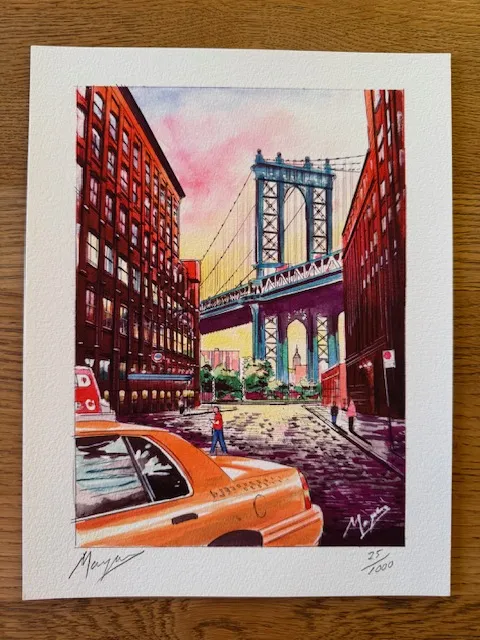
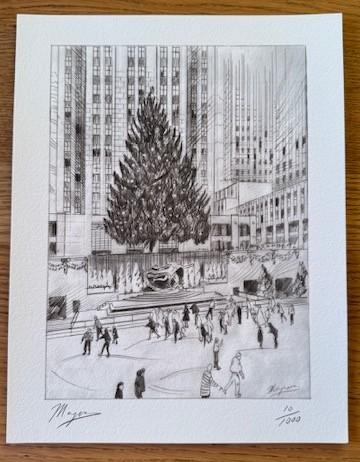
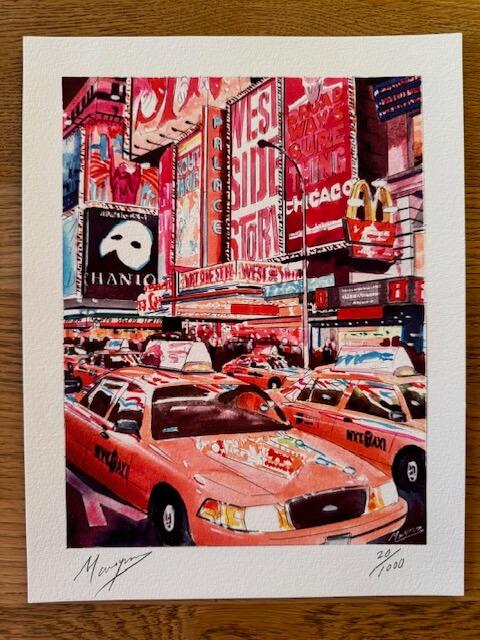
Subjects people already loved: the Brooklyn Bridge, Rockefeller Center at Christmas, Times Square.
Print.
A print shop captures the painting and prints it in two sizes.
You order one test print and check it against the original in daylight before you sell anything.
No equipment to buy. Your helper lines up two quotes side by side so you can choose without a spreadsheet.
Bruce's prints went on thick German fine art paper, signed in pencil and numbered by hand.
The test print: held beside the original in daylight before anything is sold.
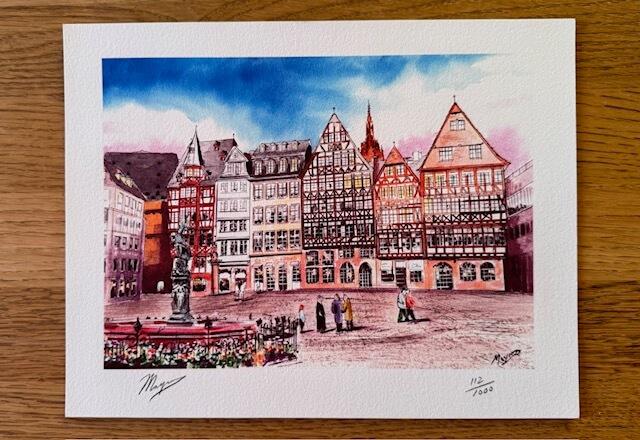
Signed in pencil, numbered by hand. High-quality art paper
Share.
A small online shop that takes payment at any hour, short videos of your hands at work that reach people who don't follow you yet, and one local place where people already shop for paintings. Your helper writes the captions. Around forty minutes a week.
Bruce's prints were sold online, to people who would never have bought one of his originals.
Your first four weeks, an evening at a time
You can see the whole path before you take the first step.
Here is each week, what it asks of you, and how long it takes.
Week 1, Choose.
About an hour or two. You pick the one painting your friends keep stopping at.
Your AI helper sorts your photos and suggests a first choice and a second.
You decide.
Week 2, Print.
About an hour. You order one test print and hold it beside the original in daylight.
That print is your first step, a signed, numbered small print a stranger can say yes to.
The original is what that stranger's loyalty can lead to later, at full price.
Week 3, Print,
checked and priced. About an hour or two.
You set the price using the starting rule in Chapter 14,
and your helper writes the little story card that goes behind each print.
Week 4, Share.
About an hour. You open your small online shop, post one short video of your hands at work,
and put one print in one place where people in your town already look at paintings.
After that, it is about forty minutes a week.
You can skip daily posting, skip the camera, and skip setting up a business.
Those are permissions, not chores.
From a stack of finished paintings
to a painting a stranger has chosen
Here's what changes for you.
Go from a stack of paintings that people admire
to one painting chosen by a simple test that a stranger is likely to buy.
Go from a painting that never gets printed
to a print a stranger can buy online, signed and numbered by hand.
Go from sitting beside your work at a fair, hoping someone stops,
to prints a stranger can order online at any hour, while you paint or sleep.
Go from freezing at "How much?"
to one plain sentence with a starting price you worked out in about ten minutes.
Go from evenings lost to admin
to an AI helper doing the words, the checks and the replies while you keep painting.
Go from worrying about fake buyers
to taking genuine orders safely, and spotting a fake one in about a minute.
Backed By Our Unconditional 30 Day Money Back Guarantee
The One-of-One Method, in four moves
Four decisions you make at the kitchen table, before you place a single drill.
One. Make the piece that can’t be looked up.
A kit design is printed on thousands of canvases.
The person looking at yours finds it in four seconds.
Somebody’s own spaniel. Their mother.
The cottage they grew up in. You send their photograph
off, and what comes back didn’t exist until they asked for it.
Nothing to compare it to. That’s the entire reason
the rest of this works.
Two. Get paid before the drills come out.
You agree the piece first. One sentence,
said the way a florist would say it, written out
word for word in Chapter Six.
The piece is sold before it exists.
No more thirty evenings on something no one ordered.
And you never buy a canvas for a painting
that hasn’t sold.
The canvas takes weeks to arrive, so you order it in week one
and sell what’s in the cupboard while you wait.
By the time it lands, you’ve had your first sale.
Three. Drill about a third of it.
You don’t have to fill the whole canvas.
A piece where only part of it sparkles looks better
than one where all of it does.
Forty by fifty, fully drilled, is thirty hours.
A third covered is ten. Same canvas, same frame,
same price. Ten hours instead of thirty.
Across a year that’s the difference between ten finished pieces
and thirty, without one extra evening.
One condition, and it’s the hinge of the whole book:
the design has to be yours. Leave a bought kit
two thirds bare and it looks unfinished,
because that canvas was printed to be covered.
Your own photograph has no symbols underneath.
Move one and move three aren’t two ideas. They’re one.
Four. You keep the evening. Somebody else gets the painting.
Every woman in this hobby paints for herself.
The evenings are lovely, and then it’s finished
and there’s nowhere for it to go.
Change one thing. Not the evening, not the tray,
not the calm.
Change who it’s for.
A woman two streets over lost her spaniel
in the spring.
A man who grew up by the harbor has almost nothing
on his walls.
A daughter would like the cottage
her mother grew up in,
and the cottage isn’t standing anymore.
Not one of them wants a diamond painting.
They want that dog, that harbor, that cottage, framed,
on the wall of the room
where they sit every evening.
So three things land at once.
You keep the hour, and still get up from it relaxed.
Somebody else ends up happy,
and it stays on their wall. And you get paid,
agreed and sold before you open the box.
You don’t trade any one of those for the others.
And you already own everything this needs
Look at what’s in the room with you right now.
The tub of drills you couldn’t use on the last
kit, the one you can’t throw away.
The pen. The tray. The wax.
The light pad you bought last time.
The finished pieces themselves, in a cupboard,
or still rolled in the tube they arrived in.
The skill. You have sat and finished pieces that most people would give up
on by the second evening.
That’s the part that usually takes a year, and you did it for fun.
A phone with a camera in it.
And somewhere between fifty and two hundred people
who already know your name.
That’s the whole list. Nothing in this ebook asks
you to buy equipment you don’t have,
learn a craft you can’t already do,
or turn into somebody you’re not.
The first evening costs about ten dollars,
and the ten dollars is for blanks.
Not for you learning anything.
You are not starting. You are pointing what you already
have somewhere new.
The second part, and why it makes this lighter
Most painters already know roughly what to do.
The doing is what wears them out.
There's a painting to choose, a title to write, a short story about it,
a price to say out loud, an online shop to open,
a video to share, and one message that needs checking because it doesn't feel right.
Your AI helper takes that list.
It ranks your paintings by the reactions they already get.
It writes your titles and the short story behind the piece.
It drafts your caption in your own voice, because it learned how you sound in five minutes.
It checks any "buyer" message against the scam patterns and tells you which to ignore.
It keeps the next task in front of you.
Jobs that might cost an afternoon of second-guessing take about ten minutes.
You decide everything.
The helper drafts, and you choose.
Your AI helper never paints for you, and it never creates an image for you to sell.
Your paintings stay yours, made by your hands.
In a market flooded with machine-made art, that is the reason a stranger will want them.
How a small print becomes an original sale
This is the part most advice leaves out.
Your online shop sells the print. Then what?
Each print buyer is a person who has already said yes to your work.
Part 3 of the book gives you a quiet way to keep that door open.
Your buyer list holds the people who bought a print, and they hear about a new original first. You don't chase anyone.
You tell the people who already love your work that a new painting exists.
That is how the same system serves each kind of buyer.
A stranger who wants something small starts with the small print.
Someone who wants more takes the larger print.
And the person who wants the painting itself already knows you,
already owns a piece of your work, and has watched you paint.
Your original is sold to her in person, at the price you set.
Is this for a painter like you?
You paint your own original work.
You have finished paintings that people admire.
You have not sold one to a stranger yet, or you sold one and couldn't repeat it.
You would rather spend your evenings painting than posting.
The ebook is written for painters in watercolour, acrylic, oil,
gouache, pastel or something close.
It is probably not the right book for digital or AI-generated images,
or for paint-by-numbers and diamond painting.
It is also honest about speed.
A first stranger sale can come within a few weeks
for some painters and take a couple of months for many, and quiet weeks are normal.
It promises no sale, because no honest book can.
This is something completely NEW
Here is what's different.
The first step is built around the way a careful buyer already thinks.
She wants to feel safe before she feels excited,
and she wants to see how the process works before she commits any money.
So the first step is small and clear, and every stage tells her what happens next.
Dear painter,
If you have wondered whether your work is good enough for strangers,
this ebook is for the day you decide to take one small, calm step.
You don't have to be certain first.
Certainty usually follows the first yes, not the other way round.
Skeptical? You should be.
You've probably seen plenty of promises about selling art,
and we'd be skeptical too.
So we won't promise you a sale, an income or a particular result.
We will show you the method, step by step, so you can judge it
against your own paintings and your own time.
Your results will vary.
They depend on your paintings,
your time and your choices,
and no one can know in advance which stranger will say yes.
Here’s
What This Means
for You
and Your Diamond Paintings...
Who is behind this, and where it comes from
You should know who wrote this before you spend $12.47.
The Art Selling System comes from the team at SmartStayGrowth,
with 19 years of marketing experience behind it.
We don't chase the latest trends.
We wrote this for painters who want their artwork
to reach the buyers who will love it, so it gets sold.
One Book. Ten Chapters. 110 Pages. One System.
Chapter 1: Most diamond painters never find out.
Who buys finished, framed diamond paintings.
Not kits, and not other diamond painters, but people who've never heard of diamond painting and don't need to.
You'll know who they are, and why you've never met them in your group.
Chapter 2: The four-second problem.
Why the obvious route disappoints almost everybody,
and why it was never your painting.
You'll get the one sentence the whole ebook runs on,
and see why a boxed kit was never a fair comparison.
Chapter 3: Where diamond painters sell.
Five places, and why the same piece can be worth twenty dollars in one
and a hundred and fifty in another.
You'll know where your first order is most likely to come from, so you can stop guessing.
Chapter 4: What to make, and who it's for.
One test for any design, and the audience you have already without knowing it.
You'll end up with a short list of real names written down,
instead of a vague idea of "an audience."
Chapter 5: The last two hours.
Fifteen dollars and two hours that turn a finished canvas into
something a person is happy to pay for.
You'll get the five-step finishing routine,
plus the one honest answer on sealing that free guides from kit companies don't give you.
Chapter 6: Made for one person.
The order, the deposit sentence, and the package that gets you talked about.
When someone asks for one of their own,
you'll have the words ready, said the way a florist would say them,
and money in your hand before you order the canvas.
Chapter 7: The tub of leftover drills.
Ten dollars, one evening, ten small things to sell.
By the end of one evening you'll have a table of keychains
and small pieces, priced where people stop looking things up and start buying.
Chapter 8: The one no one can find.
A photograph you took yourself, turned into a piece that exists nowhere else.
With Bonus Four, the AI does the design work in about a minute.
You'll have a piece that can't be priced against a kit,
and the start of a style people learn to recognize as yours.
Chapter 9: Work smarter, not harder.
A third of the drilling, for the same size and the same price.
You'll pick a layout by asking one question,
where do I want the eye to go, and turn thirty evenings
into about ten without the piece looking any less finished.
Chapter 10: Your first sale.
Four weeks, one small job a week, aimed at the moment someone hands you money for something you made.
You'll have every week mapped out,
plus three things to check if nothing has happened by the end.
Ten chapters. One method.
And it starts with a photo already on your phone, not with thirty evenings of drilling and hoping.
Plus five bonuses:
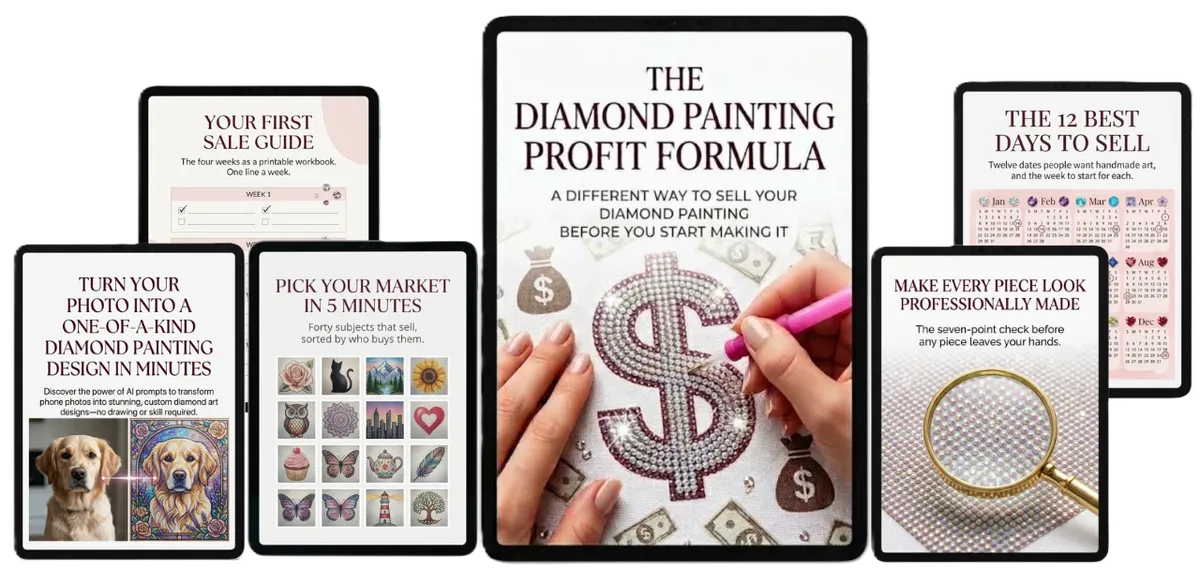
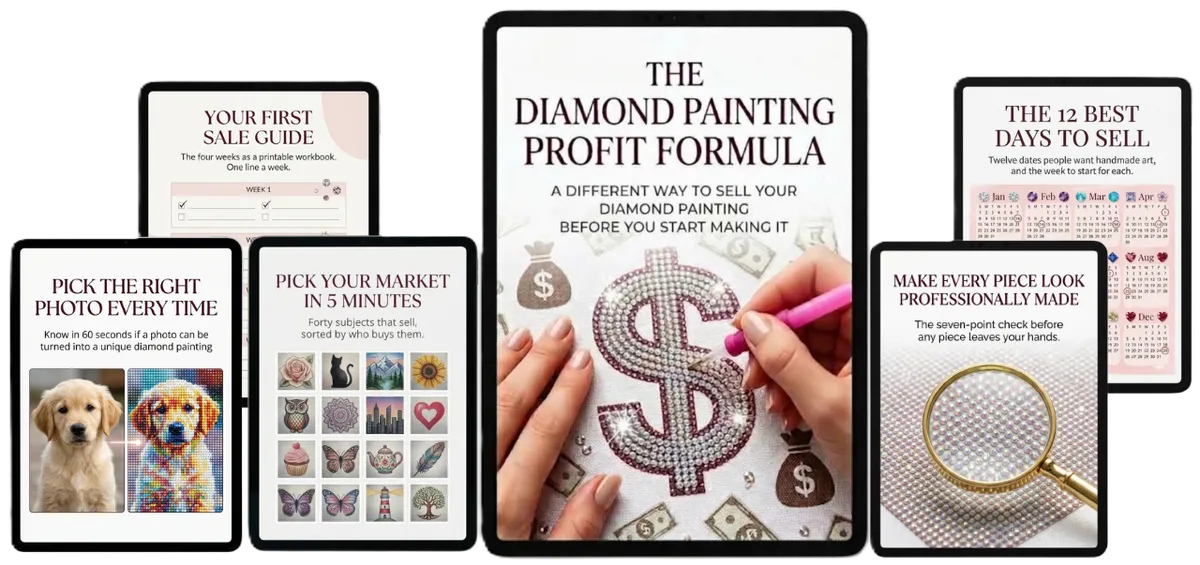
Pick Your Market in 5 Minutes
(40 subjects that sell, sorted by who buys them),
Your First Sale Guide
(a four-week workbook you print and fill in),
Make Every Piece Look Professionally Made
(the seven-point check before a piece leaves your hands),
Turn Your Photo Into A One-of-a-Kind Diamond Painting Design
(ten prompts, and the AI does the design work), and
The 12 Best Days to Sell.
So let us prove it to you
Here’s exactly
what changes
Before we started this system, we worked with Bruce, a New York watercolour painter.
He painted the city: the skyline and the sights people travel to see.
His originals had sold for thousands of dollars, until buyers for large originals became scarce.
When that happened, we tried a different approach, and we sold the image.
We photographed each painting carefully, printed it on high-quality art paper,
and released signed, numbered limited editions, sold online with his permission.
His originals stayed with him. The price was within reach for people
who had always loved his work but could never spend thousands on a painting.
Here are a few of those editions, each with its own number:
the Statue of Liberty (6/1000),
Times Square (21/1000),
Rockefeller Center at Christmas (10/1000),
drawn in pencil, and Frankfurt (112/1000).
Bruce didn’t change how he painted. He changed the first thing a buyer could say yes to.
That’s the method in this book, and you can follow it, one evening at a time,
with the paintings you already have.
That is the whole idea, and the whole of it is in this book.
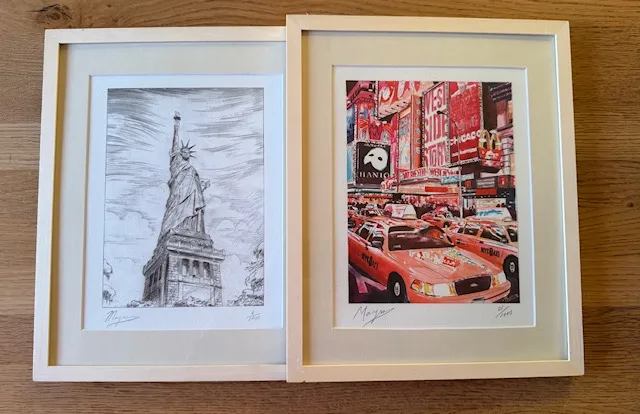
Two of Bruce’s prints, framed. Signed in pencil and numbered by hand.
Five things changed once we stopped starting at the top
The first sale came from a stranger who could say yes at a comfortable price.
The prints did the talking, so no one had to be pushed or persuaded.
Bruce's originals were no longer the only thing on offer,
and more people could bring his work home.Each buyer had a clear next step,
if they wanted one, and nothing else was asked of them.The people who bought prints began to ask about the next painting, on their own.
Why there are no star ratings on this page
There are no reviews here
because there are no buyers to quote yet,
and we won't invent any.
You can test the logic yourself instead.
Check one:
think of the last painting someone praised in your home.
Did that person buy anything from you?
Check two: look at where your paintings are seen today,
and ask whether anyone there was in a buying moment.
Check three: the stamp test in Chapter 5 shows you in a few minutes
whether a painting will print well.
Backed By Our Unconditional 30 Day Money Back Guarantee
Backed By Our Unconditional 30 Day Money Back Guarantee
A Tuesday evening with the harbour at low tide
Linda is 61, a retired school office manager who paints at her kitchen table.
She has about forty finished paintings,
and five people have mentioned the harbour at low tide, the plumber among them.
Linda is a composite, drawn from stories painters share, and is not a customer.
She sorts her photos with her AI helper, picks the harbour, and orders one test print.
She holds it beside the original in daylight, and it looks right.
She puts a few small prints on a community display at her local library,
with a story card beside them.
Nothing happens for weeks. About nine weeks in, the librarian rings.
A woman new to the area has bought one, as a reminder of her first walk along the harbour.
A few weeks later, she emails to ask about a larger print for above her new fireplace.
The original stays at full price, for the right buyer.
No gallery took a share, no shop needed rent, and no restaurant wall held her painting.
No one chased anyone.
A person who loved an image wanted more of it.
Inside, And
What Each Part Does
For You
Limited Time Special - Download The Digital Version For Only $12.47
Here's what's inside the ebook
The Art Selling System is a $12.47 ebook,
and it's built to be read slowly, one chapter at a time,
so you always know what to do next.
Part 1: The Foundation (Chapters 1 to 6)
Chapter 1: Strangers do buy paintings like yours (page 15).
Chapter 2: They love it. So why hasn't a stranger bought it? (page 33).
Chapter 3: One painting, many homes (page 49).
The three steps: a small print, a larger print, your original.
Chapter 4: Paint for people who love what you love (page 69).
How to find your passionate people, so you know who each painting is for.
Chapter 5: Paint it so it prints well (page 88).
The three phone checks that tell you whether a painting will print well.
Chapter 6: The Stack Sort (page 99). Picks your first painting from your whole stack.
Part 1 milestone: your first painting is chosen and ready to print.
Part 2: Sell Prints Online (Chapters 7 to 11)
Chapter 7: From canvas to print (page 117).
You turn your chosen painting into prints you're proud of,
with no equipment and no technical skill.
You get: a print that matches the original, in two sizes, ready to sell.
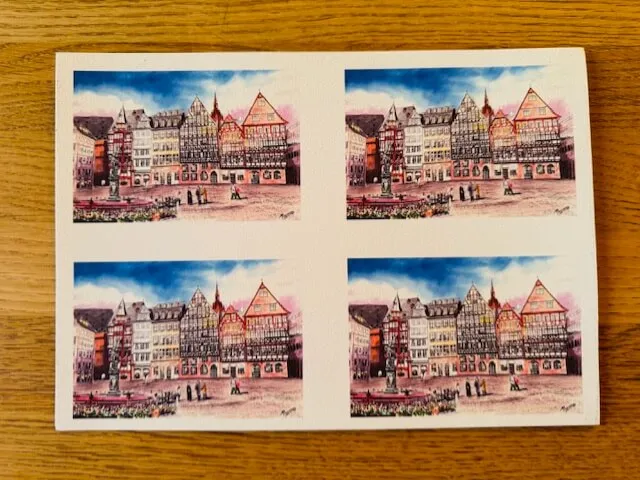
One painting, several prints.
Chapter 8: A Look People Trust (page 139).
You put your name, your signature and three kinds of photo on a short page, with no face needed.
You get: a page that tells a stranger who made the painting and why they can trust it.
Chapter 9: Your Little Online Shop (page 149).
You set up one simple place where anyone can buy your prints, at any hour.
You get: an online-shop that takes orders while you sleep,
with a silent-shop check to make sure it reads clearly.
Chapter 10: Being Seen Online (page 160).
You make short, face-free videos of your hands at work, two a week,
and share them where people who love your style already gather.
You get: a steady way to be seen by new people, without performing or chasing followers.
Chapter 11: Growing with Ads, When You're Ready (page 172).
You learn a small, careful ad test with a firm limit, for later, when your shop is already working.
You get: a way to grow only when you choose to, and with plain numbers you can check.
Part 2 milestone: your first print is live in your shop and being seen online.
Part 3: Sell Originals Personally (Chapters 12 to 15)
You are not chasing anyone in this part.
The people who already love your prints come to you, at their own pace.
Chapter 12: Selling Originals in Person (page 185).
Offer a first look, a studio visit or a face-free video call, with no pressure at all.
You get plain words for the moment someone asks "How much?", so you can answer calmly.
Chapter 13: Local Doors and Your Town's Story (page 195).
Two local doors, a local shop window or a library display, and one friendly email to your local paper.
You get a story about your town that people already care about.
Chapter 14: The First Yes (page 215).
A calm way to close the sale: a price you can say out loud, a safe way to be paid,
and a check that spots a fake buyer in about a minute.
Chapter 15: Climbing the ladder (page 231).
Each buyer climbs at their own pace,
and the people who own your prints hear first when a new original is ready.
Part 3 milestone: the people who love your prints can find their way to an original.
Not ready yet? Fair enough. Here’s where each step sits,
page by page
Backed By Our Unconditional 30-Day Money-Back Guarantee
Excellent based on 456 reviews
What Are Others Saying About Our Model?
"The AC Model Allowed Me To Scale My Business Beyond 7-Figures. Thanks Automatic Clients!"
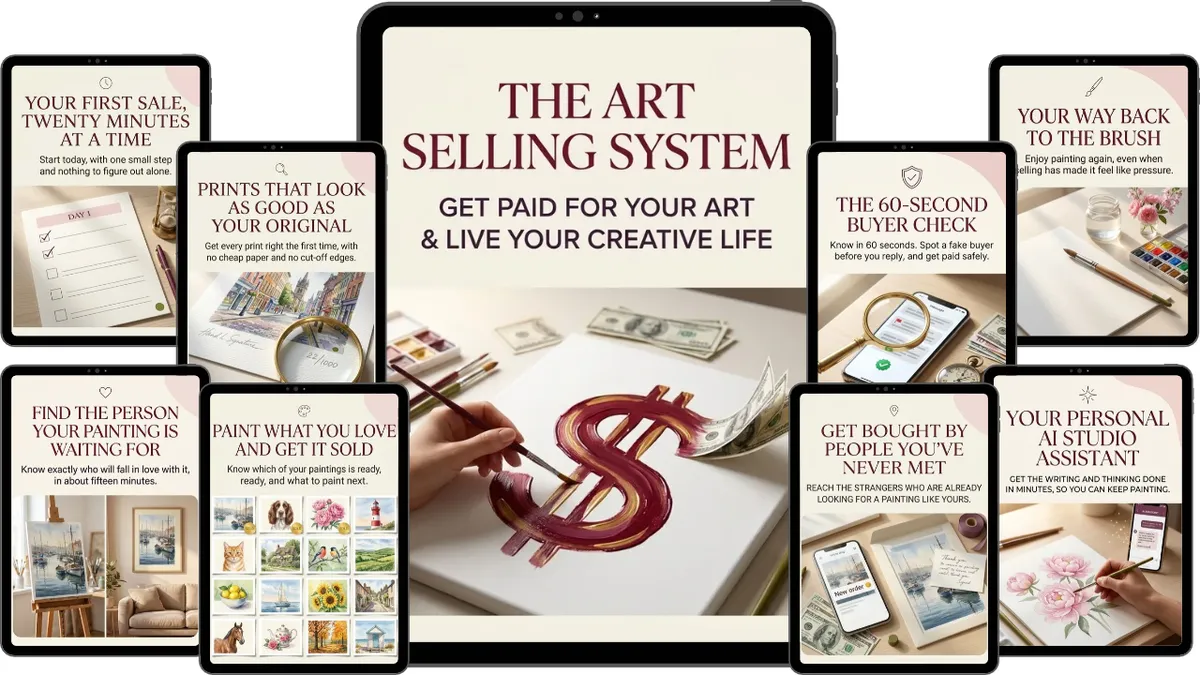
Here's Everything You're Getting
For Only $12.47 Today
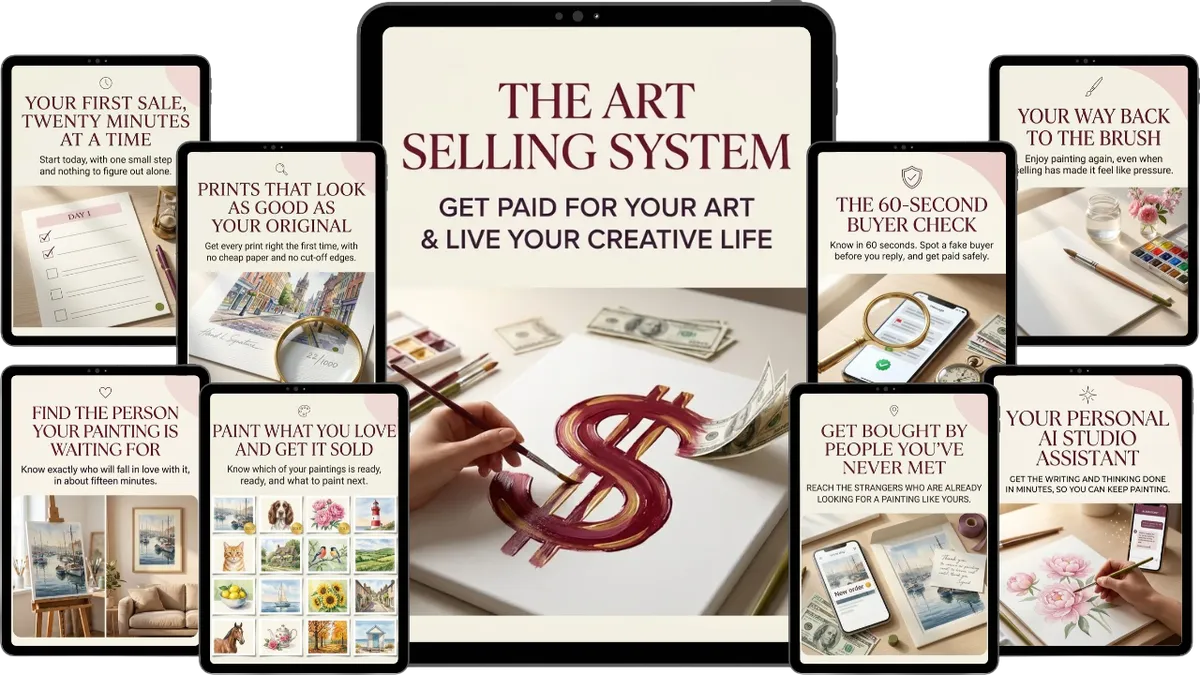
The book, plus 8 bonuses, all included today
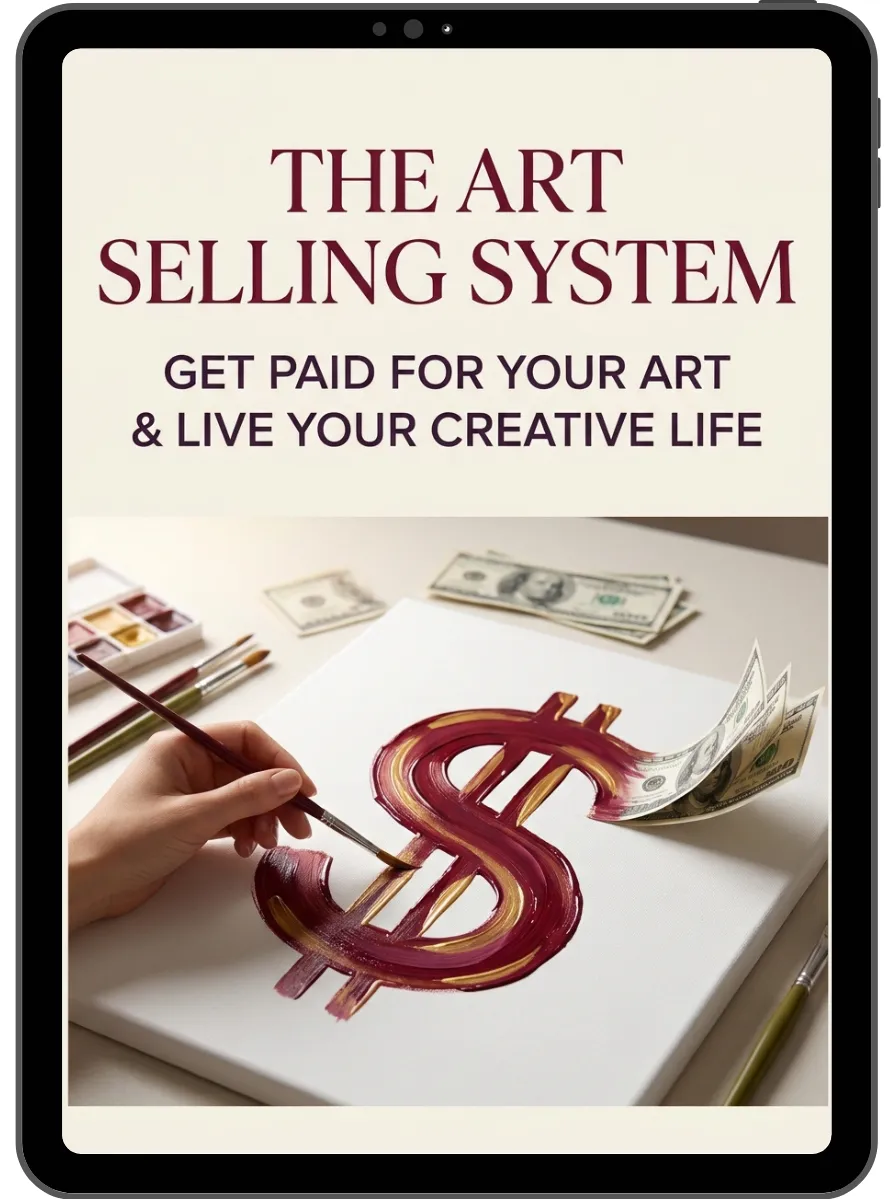
The Art Selling System
- Get Paid for Your Art & Live Your Creative Life
The ebook, The Art Selling System, with 15 chapters in 3 parts, one map, and 59 ready-to-use AI prompts. All eight bonuses are included in the $12.47
What it gets you: one calm path from the stack of finished paintings in your spare room to a print a stranger can order online, at any hour, for her own wall.
It's the same route we took with Bruce in 2017,
set out one evening at a time,
with your AI helper doing the tiring parts.
Your originals go to the people who love them most,
at their full price.
INSTANT ACCESS | Price: $37 $12.47
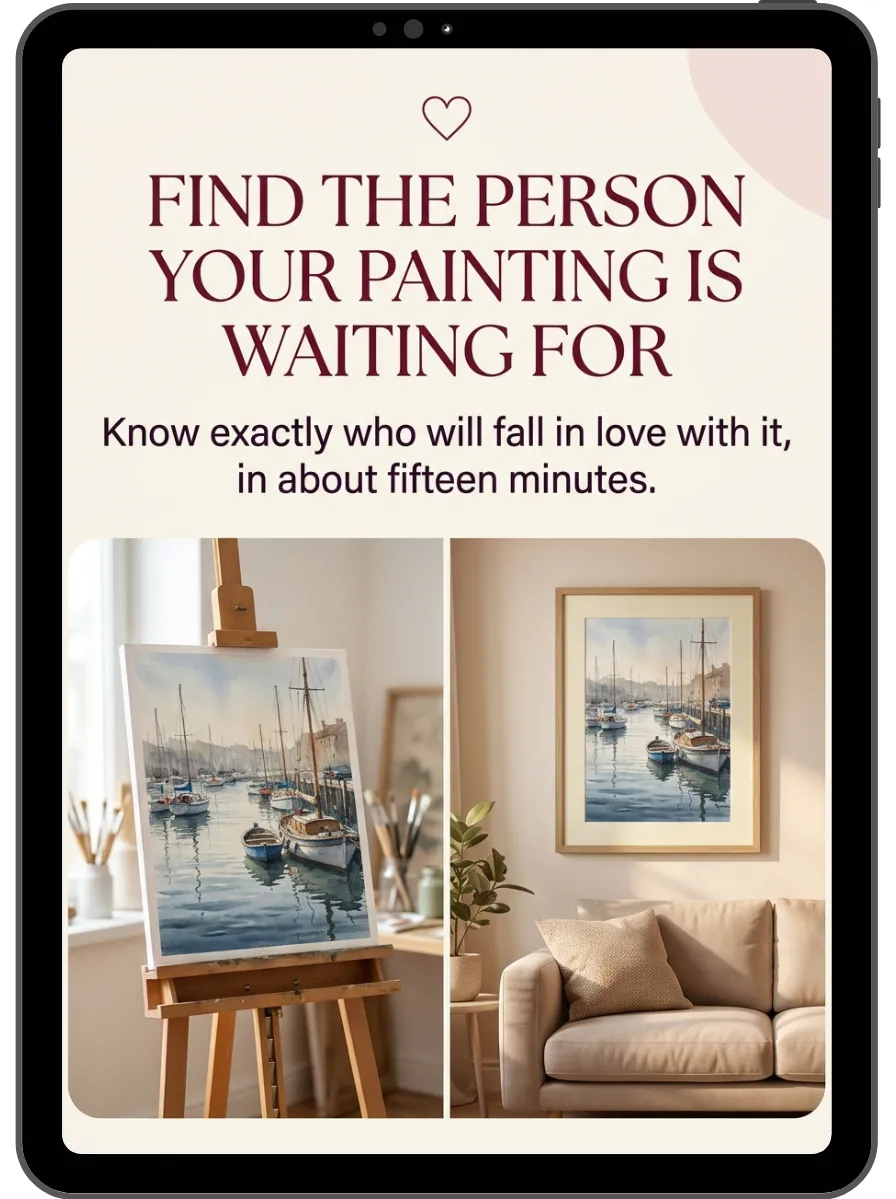
Gift #1
Find The Person Your Painting
Is Waiting For.
(Digital PDF Download)
Know exactly who will fall in love with it, in about fifteen minutes.
You get: a clear picture of the one buyer your painting is waiting for, so every title, caption and price speaks to someone.
INSTANT ACCESS | Price: $12 FREE
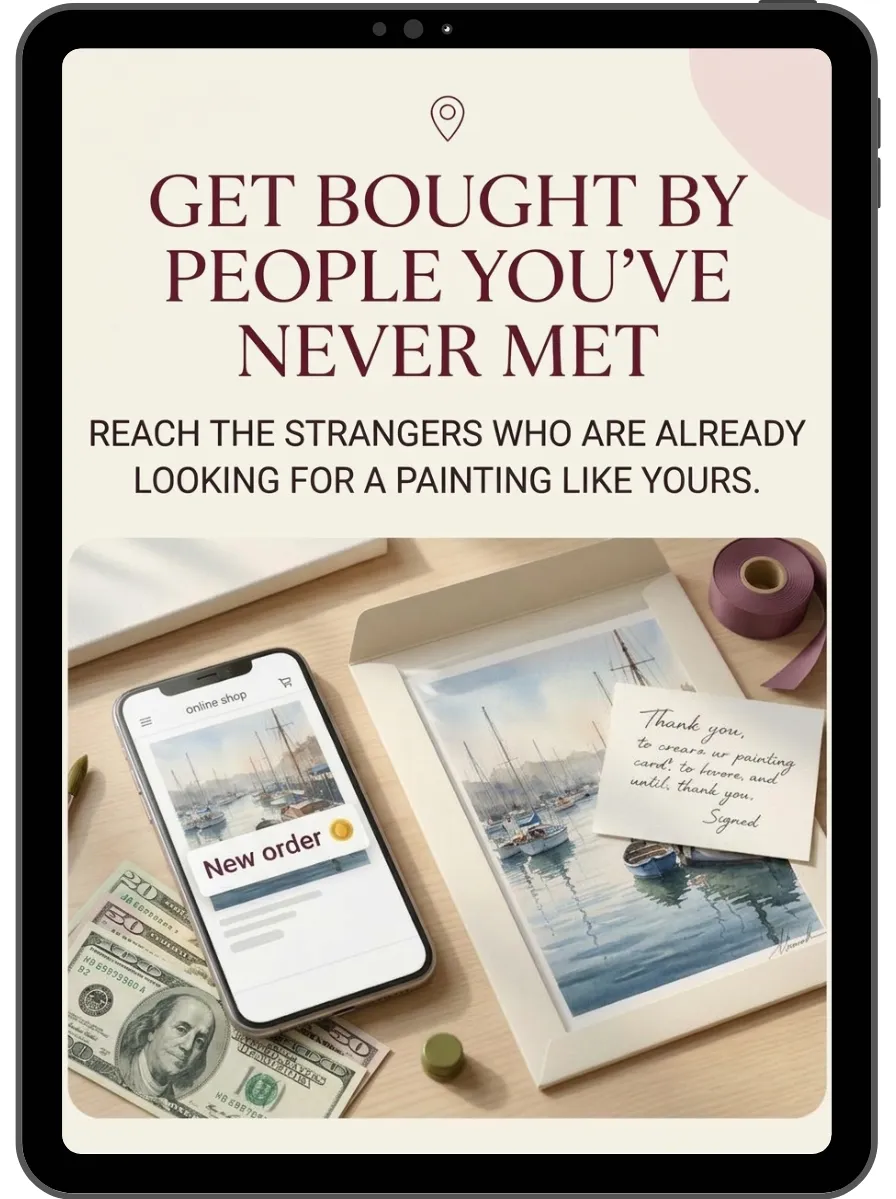
Gift #2
Get Bought By People You've Never Met.
(Digital PDF Download)
Reach the strangers
who are already looking for a painting like yours.
You get: three places where strangers already look for paintings, so your work is seen by people beyond your friends.
INSTANT ACCESS | Price: $12 FREE
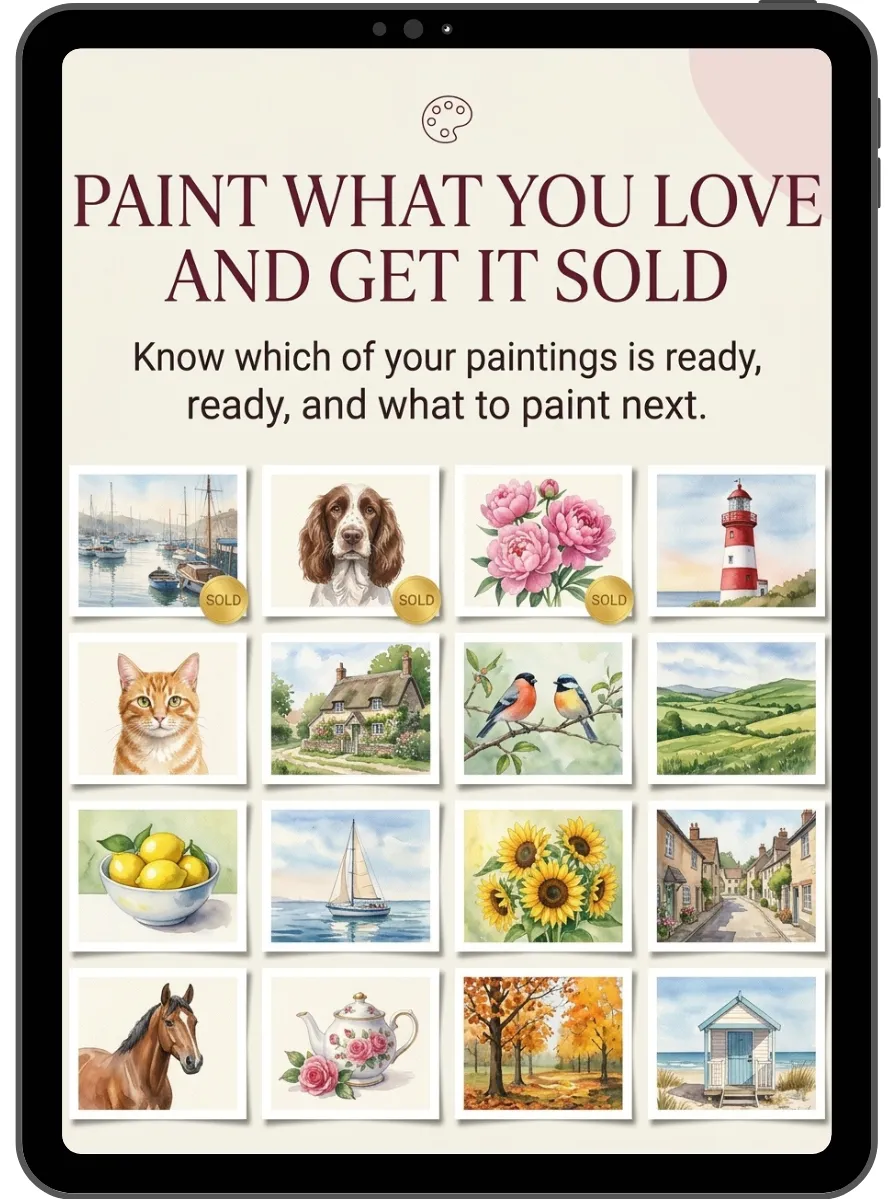
Gift #3
Paint What You Love And Get It Sold.
(Digital PDF Download)
Know which of your paintings is ready, and what to paint next.
You get: three painting ideas from subjects you already love, so you keep painting your own work and it finds its buyer.
INSTANT ACCESS | Price: $12 FREE
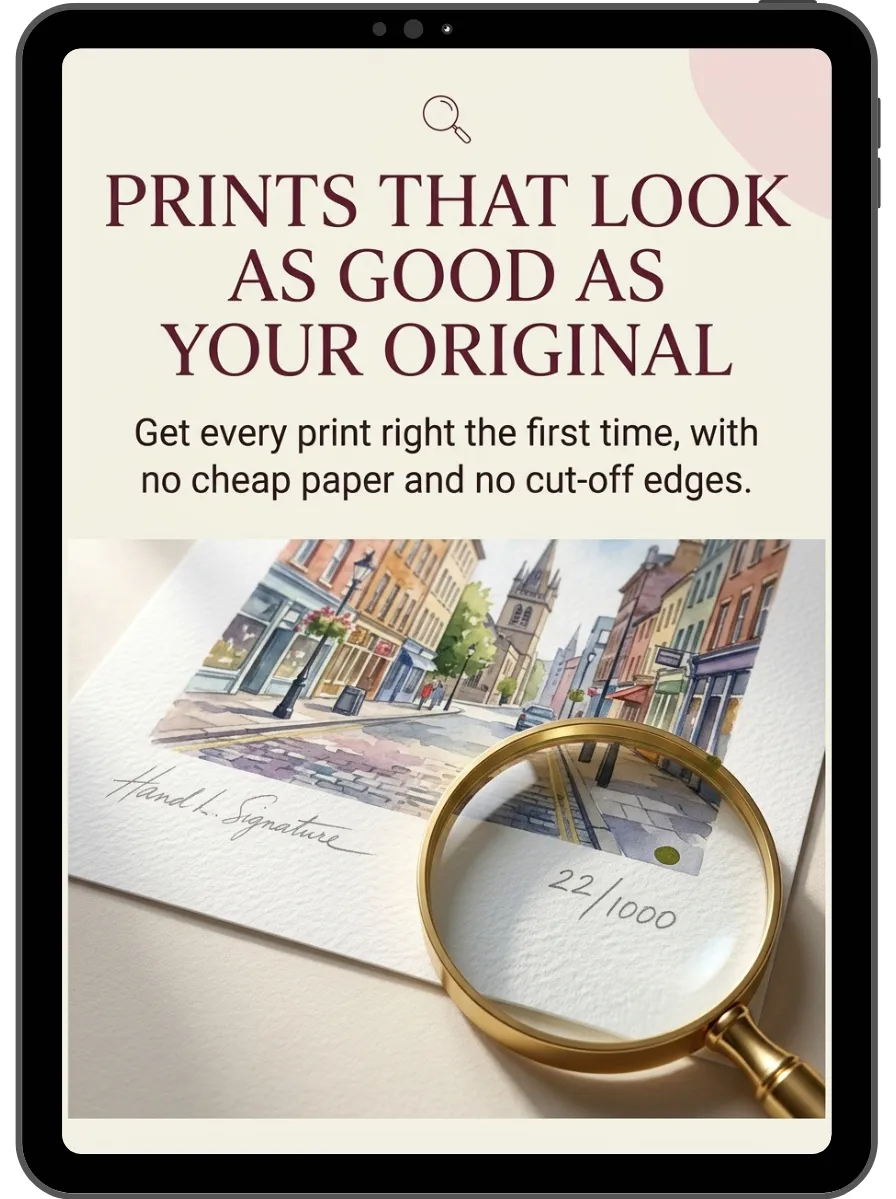
Gift #4
Prints That Look As Good As Your Original.
(Digital PDF Download)
Get every print right the first time,
with no cheap paper and no cut-off edges.
You get: a print you are proud to sign, number and send.
INSTANT ACCESS | Price: $12 FREE
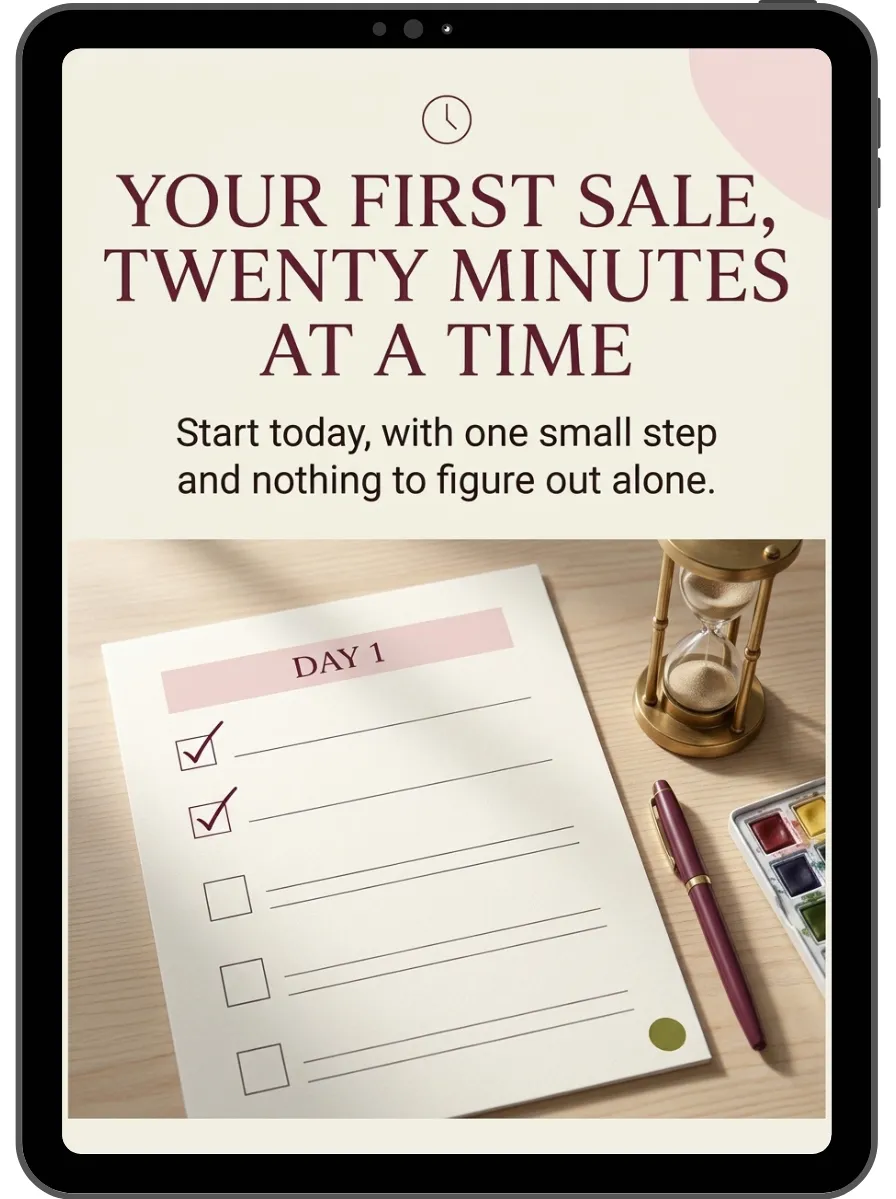
Gift #5
Your First Sale, Twenty Minutes At A Time.
(Digital PDF Download)
Start today, with one small step and nothing to figure out alone.
You get: a first-sale path you can start today, one small step at a time.
INSTANT ACCESS | Price: $12 FREE
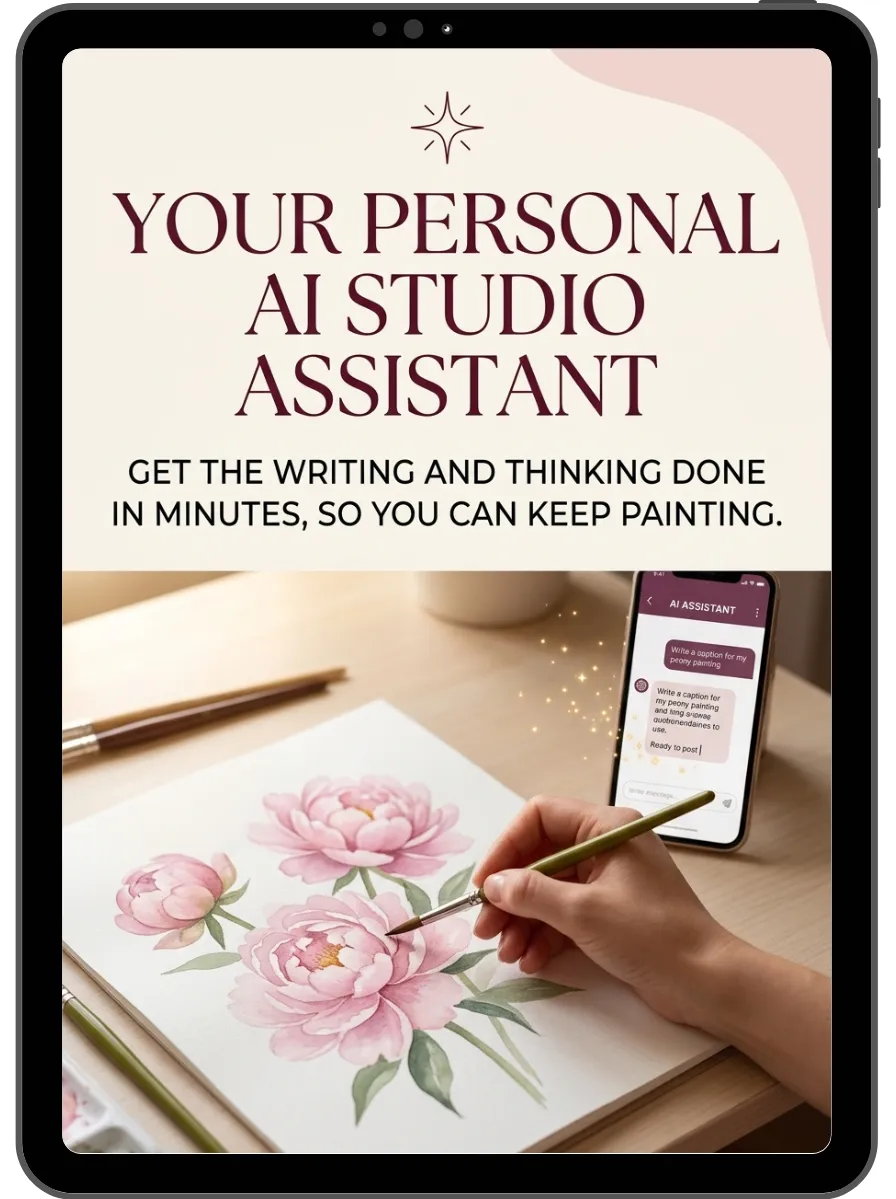
Gift #6
Your Personal AI Studio Assistant.
(Digital PDF Download)
Get the writing and thinking done in minutes,
so you can keep painting.
You get: every AI prompt from the book in one place, ready to copy and paste, so the chores take minutes instead of evenings.
INSTANT ACCESS | Price: $12 FREE
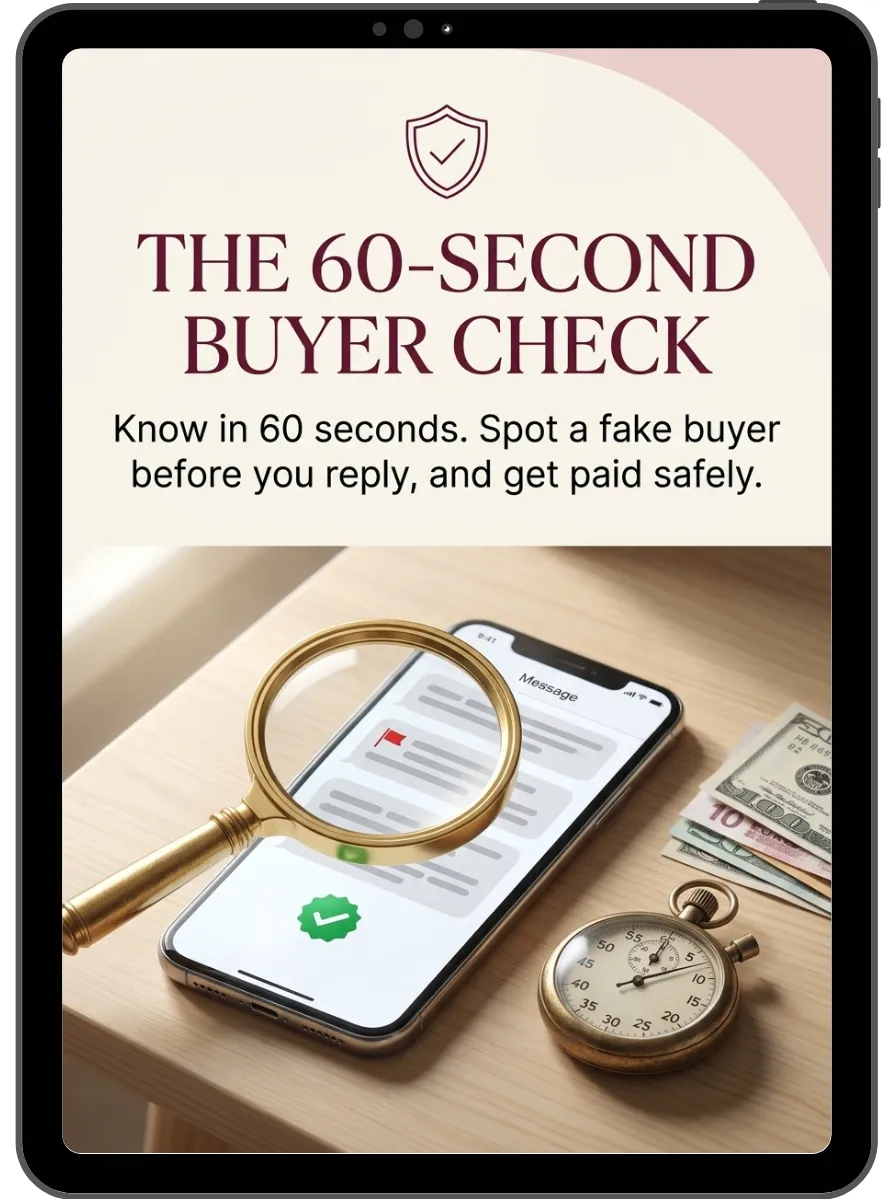
Gift #7
The 60-Second Buyer Check.
(Digital PDF Download)
Know In 60 Seconds.
Spot a fake buyer before you reply, and get paid safely.
You get: the confidence to answer a buyer's message and get paid safely.
INSTANT ACCESS | Price: $12 FREE
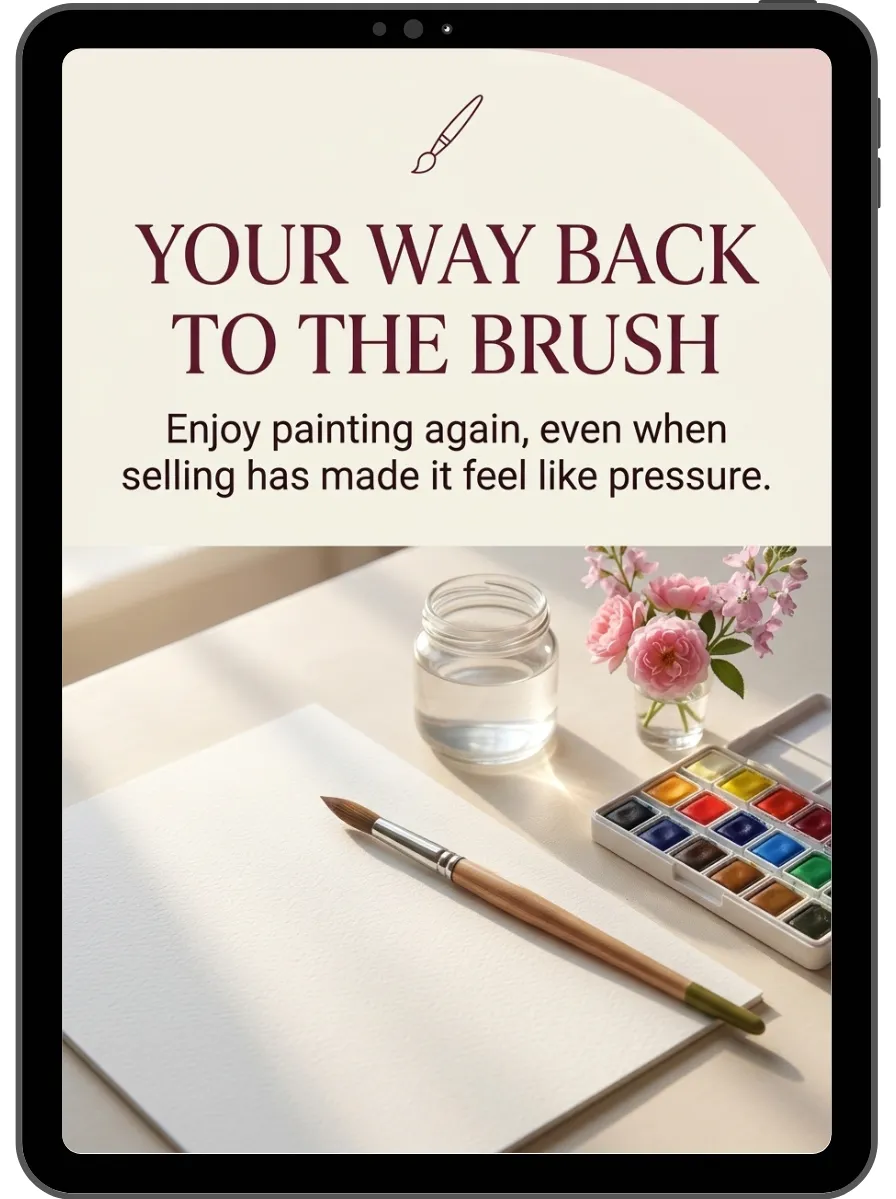
Gift #8
Your Way Back To The Brush.
(Digital PDF Download)
Enjoy painting again,
even when selling has made it feel like pressure.
You get: gentle ways back to your brush, so painting stays a joy.
INSTANT ACCESS | Price: $12 FREE
Everything on the list comes in one download, in your inbox within a couple of minutes of buying.
Nothing is held back, nothing arrives later, and nothing else gets charged.
One download, 253 pages . EBook+ 8 PREMIUM Gifts.
Bought as separate pieces, the 9 items come to $133.
Here they're one download for $12.47.
Backed By Our Unconditional 30-Day Money-Back Guarantee
Why Just $12.47,
when the pieces of it are stated at $133
Two reasons, and you may as well have both.
The first reason: it's an ebook, so it costs almost nothing to send.
Pricing it high would keep this from the women
who most need to hear their work is worth something.
The second reason: we want you glad you bought it, and wanting the next one from us
That’s the whole model, and it’s better said plainly than dressed up.
So: $12.47. About what you'd spend on a frame you never used.

Your Purchase Is Backed By Our Unconditional Money Back Guarantee
We know that before we get into anything… We would like to know what we are buying and that it’s backed by a solid money-back guarantee.
And we want you to be comfortable with this purchase.
And even though it’s only $12.47 – you worked for that money and it counts.
Like our grandpas used to say “Test drive the car before you drive it off the lot”…
So here’s what we’ve arranged:
Download the eBook, read it, but more importantly apply what you learn in there.
And if you’re not blown away by what you learn.
Then just shoot us an email at [email protected] and request a refund within 30 days.
We’ll refund you your $12.47 and let you keep the [product name] free of charge.
You’ll have it — and you keep the book, the gifts and the whole Prompt Library. There’s nothing to send back and nothing to explain.
How’s that for a money back guarantee? We’d say pretty good!
Frequently Asked Questions
Need help? [email protected]
I want this, what exactly am I getting?
You are getting a copy of The Art Selling System ebook, available instantly.
You are getting the 253-page ebook with all 15 chapters in three parts, and all eight premium gifts, with 59 ready-to-use AI prompts - 289 pages in all. One digital download, delivered instantly
I've never sold anything. Can I start?
Yes. Most people who have never sold begin with one small print a stranger can say yes to, not an original at the top of the ladder. The ebook walks you through choosing that first painting, printing it well and pricing it so it feels like an easy yes.
Won't prints cheapen my original?
Your original is sold at full price as the top step, and the print buyer is the person most likely to ask about it later.
Do I have to show my face?
No. You don't have to appear on video at any point. The ebook shows you how to show your painting, your signature and your story without your face in a single frame, and that's how many painters in the book sell their first prints.
How much time will it take?
It depends on the stage you're in. Setting up your first print and shop takes a few evenings, one at a time. After that, many painters spend around forty minutes a week on the shop and the videos, and the rest of the week goes back to painting.
I’ve never used ChatGPT or Gemini and other AI. Is this going to be complicated?
No. Each box in the book is copy, fill in the brackets, read what comes back. One helper you already have on your phone is plenty.
Is this a get-rich-quick system?
No. Nothing in the ebook promises a sale, an income or a particular result, and it doesn't ask you to buy expensive courses or equipment. It shows you one honest path, one small step at a time.
Is there a guarantee?
Yes. If it's not for you, you get a full 30 day refund and you keep the eBook and PREMIUM gifts.
P.S. Print one small test copy of your favourite painting and hold it beside the original in daylight.
If the print looks like the painting, you already have your first step.
P.P.S. The Art Selling System is $11.47.
Download the ebook now for $12.47, and start with one painting, one print and one stranger who chooses it.
We can not and do not make any guarantees about your ability to get results or earn any money with our ideas, information, tools, or strategies. What we can guarantee is your satisfaction with our training. We give you a 30-day 100% satisfaction guarantee on the products we sell, so if you are not happy for any reason with the quality of our training, just ask for your money back. You should know that all products and services by our company are for educational and informational purposes only. Nothing on this page, any of our websites, or any of our content or curriculum is a promise or guarantee of results or future earnings, and we do not offer any legal, medical, tax, or other professional advice. Any financial numbers referenced here, or on any of our sites, are illustrative of concepts only and should not be considered average earnings, exact earnings, or promises for actual or future performance. Use caution and always consult your accountant, lawyer or professional advisor before acting on this or any information related to a lifestyle change or your business or finances. You alone are responsible and accountable for your decisions, actions and results in life, and by your registration here you agree not to attempt to hold us liable for your decisions, actions, or results at any time, under any circumstance.
This product is brought to you and copyrighted by SmartStayGrowth
SmartStayGrowth
We can not and do not make any guarantees about your ability to get results or earn any money with our ideas, information, tools, or strategies. What we can guarantee is your satisfaction with our training. We give you a 30-day 100% satisfaction guarantee on the products we sell, so if you are not happy for any reason with the quality of our training, just ask for your money back. You should know that all products and services by our company are for educational and informational purposes only. Nothing on this page, any of our websites, or any of our content or curriculum is a promise or guarantee of results or future earnings, and we do not offer any legal, medical, tax, or other professional advice. Any financial numbers referenced here, or on any of our sites, are illustrative of concepts only and should not be considered average earnings, exact earnings, or promises for actual or future performance. Use caution and always consult your accountant, lawyer or professional advisor before acting on this or any information related to a lifestyle change or your business or finances. You alone are responsible and accountable for your decisions, actions and results in life, and by your registration here you agree not to attempt to hold us liable for your decisions, actions, or results at any time, under any circumstance.
This product is brought to you and copyrighted by SmartStayGrowth
Art Selling System
Only $142 $13.87 Today
Download The eBook + 5 Free Bonuses For $108 Just $13.87! Delivered instantly. Start reading in the next 2 minutes.